
Culture is already happening
Every club has a culture, whether it has written it down or not.
It shows up in the way a new family is welcomed, how a coach responds to a mistake, whether players feel included, how volunteers communicate and whether people feel that their contribution matters.
Culture isn't created by a document on a noticeboard.
It is created by what people experience, repeatedly.
That means clubs have an opportunity to shape culture through the everyday things they already do — how teams are organised, how coaches communicate, how players are supported, how attendance is handled and how development is discussed.
Make the good choices visible
A positive culture starts with being clear about what matters.
Perhaps your club values respect, inclusion, effort, development and teamwork. The important thing is not simply choosing the words. It is making those behaviours visible in everyday club life.
For example, recognising a player for helping a teammate can reinforce teamwork more effectively than simply telling players that teamwork is important.
The same applies to coaches and volunteers.
A coach who consistently encourages players after mistakes is demonstrating the culture the club wants to create. A manager who communicates clearly with families is doing the same.
People remember how a club made them feel.
Give coaches the tools to reinforce it
Culture is often experienced most directly through the coach.
Coaches are working with players every week, making decisions, giving feedback and creating the environment in which development takes place.
ClubSort's Plans can help make that environment more intentional.
Rather than focusing only on drills and activities, training plans can be used to structure sessions around development objectives, teamwork and the behaviours a coach wants to encourage.
Sharing plans across a team also helps create consistency. Players shouldn't have completely different experiences simply because different coaches organise their sessions differently.
Make development about more than performance
A positive club culture recognises that player development is bigger than results.
Assessments give clubs a structured way to define the areas they want players to develop, while Reviews give coaches an opportunity to reflect on how an individual player is progressing.
That creates a more balanced conversation.
Instead of every discussion being about goals, wins or mistakes, coaches can talk about development, effort, decision-making, teamwork and other areas that contribute to a player's experience.
This is particularly important for younger players, where confidence and enjoyment can be just as important as technical improvement.
Create consistency across teams
Culture becomes difficult when every team operates according to completely different expectations.
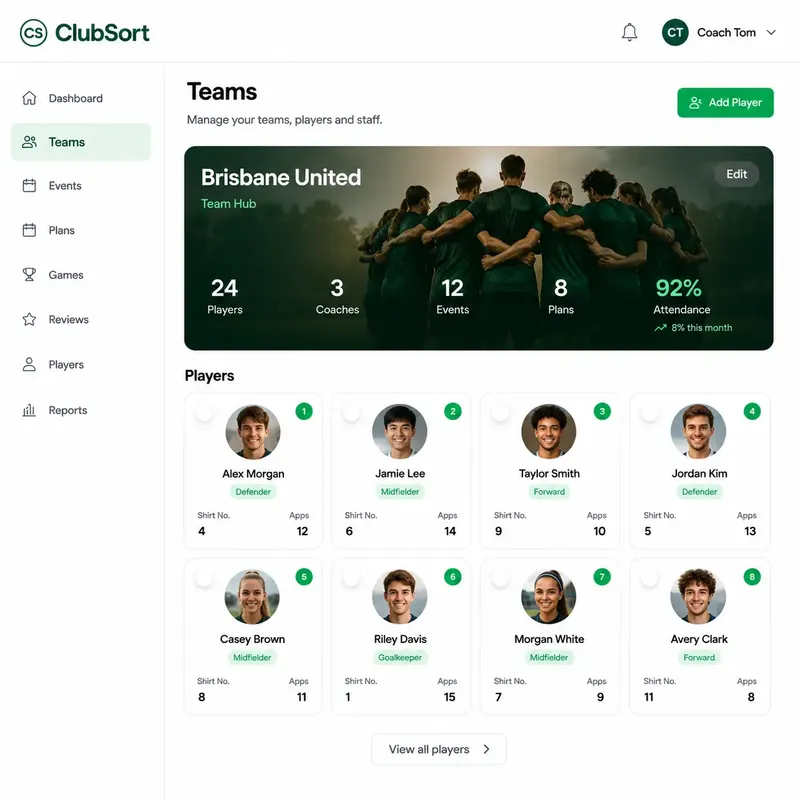
ClubSort's team structure helps clubs establish a common framework while still allowing coaches to run their own teams.
Teams, players, coaches, events and plans can all be connected within the same club environment.
That makes it easier for everyone to understand where they fit and gives the club a shared structure without removing the personality of individual teams.
The goal isn't to make every team identical.
It is to make sure that the fundamental expectations of the club remain consistent.
Communication is part of culture
Good communication is one of the simplest ways to create a positive experience.
Families should know when events are happening. Players should know what is expected of them. Coaches should have access to the information they need. Managers shouldn't have to repeatedly chase people for basic information.
ClubSort's Events provide a shared place for teams and members to see what is happening, while attendance information helps coaches and managers understand who is available.
That may sound like administration, but good administration has a cultural impact.
When people know what is happening and what is expected, there is less confusion and more time for the things that actually matter.
Recognise participation, not just results
Winning is visible.
So are goals, scores and trophies.
But the contributions that build a healthy club are often much quieter.
- A player who keeps encouraging teammates.
- A coach who stays behind to help someone improve.
- A parent who volunteers when help is needed.
- A player who welcomes someone new to the team.
These are the behaviours worth noticing.
Attendance information can also help clubs understand participation over time. It provides context around whether players are regularly involved, rather than reducing their contribution to what happens on match day.
The more a club recognises these contributions, the clearer its culture becomes.
Use game day to reinforce the same values
Culture doesn't stop when training starts.
Matches are often where the values of a club are tested most visibly.
Game tracking can help coaches and managers focus on what is happening during a match rather than trying to remember everything afterwards. Player rotations, periods and participation can be managed using the structure already defined for the team and age group.
That creates an important distinction.
The technology isn't there to replace the coach's judgement. It is there to remove some of the administration around the game so the coach can concentrate on the players.
Make everyone part of it
A healthy culture belongs to the whole club.
- Players experience it.
- Coaches shape it.
- Families reinforce it.
- Managers coordinate it.
- Directors and custodians set the expectations for it.
That means culture shouldn't be something imposed from the top and forgotten.
Give people opportunities to contribute. Ask players what makes them enjoy being part of the club. Listen to coaches about the challenges they face. Pay attention to what families experience. Then look for the gaps between the culture you want and the culture people are actually experiencing.
ClubSort provides the structure to support those conversations, but the culture itself still comes from people.
Culture is built one interaction at a time
There is no single feature, policy or meeting that creates a positive club culture.
- It comes from hundreds of small decisions.
- How a new player is welcomed.
- How a coach responds to a mistake.
- How a review is delivered.
- How a team communicates with families.
- How effort is recognised.
- How players are given opportunities to participate.
- How the club responds when something doesn't go according to plan.
Those moments add up.
A strong club culture isn't something you announce. It's something people experience.
The role of ClubSort is to provide the structure that helps clubs make those experiences more consistent — connecting teams, players, plans, events, attendance, assessments and reviews in one place.
Because when the administration is organised, clubs have more space to focus on what matters most: the people who make the club what it is.