
Start with the information your club needs
Not every club wants to record every detail of every game.
Some clubs need a consistent way for teams to record attendance, confirm who played and keep game tasks in one place. That alone can replace scattered messages, paper notes and different spreadsheets for each team.
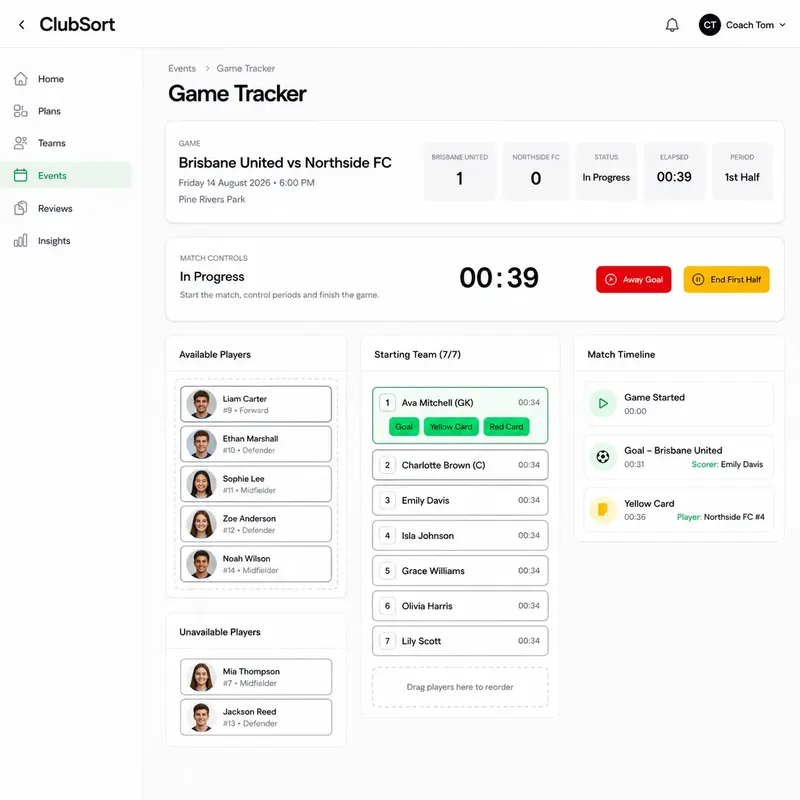
Other clubs want to understand participation in more detail. They may want to track starts, minutes, substitutions, positions, goals, cards or other game actions, then use that information to support coaching and player development.
ClubSort supports both approaches.
One connected record, different levels of detail
The important thing is not collecting the most data possible. It is collecting useful data consistently.
A club can establish a simple shared process:
- Teams record who attended.
- Coaches confirm the game squad and participation.
- Game tasks are assigned and followed up.
- The club has a reliable record of activity.
That gives club leaders a clearer view of which teams are active and helps coaches spend less time searching for basic information.
When a club is ready for more detail, the same workflow can go further. Game Tracker can capture starts, player time, substitutions, positions and other match actions. Those records can then contribute to player and team insights without asking coaches to maintain a separate system.
Detail when it helps
Detailed data is valuable when it answers a real coaching question.
- Is a player getting appropriate opportunities?
- How is game time distributed across a team?
- Which positions has a player experienced?
- Are training plans, attendance and game participation telling the same story?
- What should be discussed in the next player review?
A club does not need to answer every question on day one. It can begin with a consistent attendance process and add detail as its coaching approach develops.
A flexible club-wide standard
Flexibility does not mean every team has to invent its own process. ClubSort allows a club to standardise the information that matters across teams while leaving room for different levels of coaching detail.
A community club might start with attendance and game participation. A performance-focused program might also record position changes, minutes, starts and match actions. Both clubs can use the same connected structure of teams, coaches, events and players.
That creates a useful balance: enough consistency for club-wide visibility, and enough flexibility for coaches to work in a way that suits their teams.
The data becomes more useful over time
The value grows as records connect.
Attendance shows who was involved. Game tracking shows what happened during the match. Reviews add structured coaching feedback. Together, they give coaches and club leaders a more complete picture of a player's experience and development.
The goal is not to turn coaching into data entry. It is to make the information a club already collects easier to use, compare and act on.
ClubSort can be as simple as a shared team process, or as detailed as a club needs its coaching insight to be.