
Coaching starts before the session
For coaches, the hardest part of training isn't always the session itself.
There are players to consider, activities to organise, equipment to prepare and coaching points to remember. Add team communication, changing schedules and the demands of a busy club, and planning can quickly become another job on top of coaching.
The goal isn't to remove planning.
It's to make planning simpler.
A good training plan should give a coach confidence about what they want to achieve while still leaving enough flexibility to respond to the players in front of them.
Start with a clear purpose
Before choosing an activity, decide what the session is trying to achieve.
That might be improving possession, developing finishing, working on defensive shape or preparing the team for an upcoming game.
Once the purpose is clear, the rest of the session becomes easier to structure.
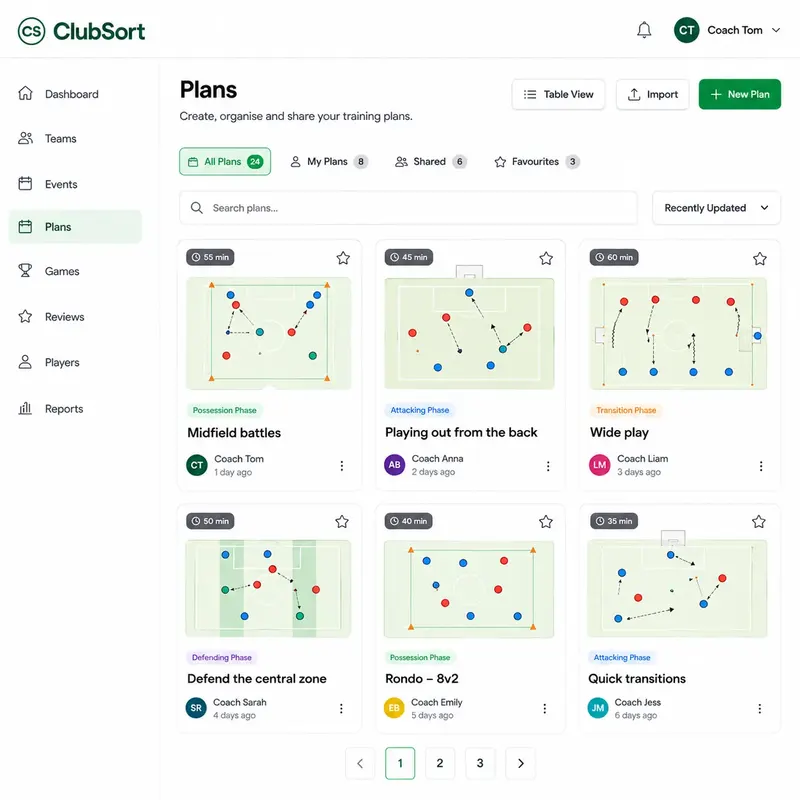
ClubSort's Plans provide a place to bring those ideas together, combining the session structure, activities and visual elements into a single plan that can be revisited later.
Instead of searching through notes, messages or separate documents, the coach has one place to start.
A good plan gives the session direction without taking away the coach's judgement.
Build a repeatable structure
Not every training session needs to be reinvented.
A simple structure can make planning faster while still allowing the content to change.
For example:
- Warm up — prepare players physically and mentally
- Technical activity — focus on the key skill
- Game-related activity — introduce decision-making and pressure
- Small-sided game — apply the ideas in a realistic situation
- Review — reinforce the key coaching points
The activities can change from week to week, but the overall structure provides a familiar starting point.
That means coaches spend less time wondering how to organise a session and more time thinking about what their players actually need.
Use visual planning to explain the idea
Some coaching concepts are difficult to describe with words alone.
Player movements, positioning, passing options and areas of the field are often much easier to understand when they can be seen.
ClubSort's visual Plan tools allow coaches to create diagrams that show how an activity should work.
A coach can illustrate the starting positions, movement patterns and key actions, then use the same plan as a reference when delivering the session.
This also makes plans easier to share with other coaches.
A diagram can often communicate an idea in seconds that would otherwise require a long explanation.
Build a library, not a pile of notes
One of the biggest benefits of digital planning is that good ideas don't have to disappear after the session.
A particularly effective activity can be saved and reused.
A session that works well for one age group might also provide the starting point for another. A coach can duplicate or adapt an existing plan rather than starting with a blank page every time.
Over time, this creates something much more valuable than a collection of individual sessions.
It creates a club knowledge base.
Experienced coaches can contribute ideas that newer coaches can learn from, while successful sessions can be refined and reused across teams.
Share the workload
Training planning doesn't have to happen in isolation.
Clubs often have multiple coaches working with similar age groups or development objectives. Sharing plans can help those coaches learn from each other and create greater consistency across the club.
ClubSort's plan sharing makes it easier to give other coaches access to useful sessions without requiring everyone to recreate the same work.
That doesn't mean every coach has to run the same session.
Instead, coaches have a common starting point that they can adapt to their own players.
Connect planning with player development
Training becomes more meaningful when it connects to what the players actually need to develop.
ClubSort's Assessments can help clubs define the areas they want to evaluate, while Reviews provide coaches with a structured way to reflect on individual player development.
Those insights can feed back into training.
If a player needs to improve a particular technical skill, decision-making ability or aspect of their game, the coach can consider how future sessions can provide opportunities to work on it.
The plan then becomes more than a list of activities.
It becomes part of an ongoing development process.
Plan for the players in front of you
Even the best training plan shouldn't be treated as a script.
Players may arrive tired. An activity may be easier or harder than expected. The weather may change. Something from the previous game may suddenly become more important.
A good plan gives the coach a framework, not a set of instructions that cannot be changed.
That is why keeping the session purpose and key coaching points clear is so useful. When circumstances change, the coach can adapt the activities while still working towards the same objective.
The plan should support the coach, not control the coach.
Learn from every session
Training planning becomes more effective when coaches look back as well as forward.
- Which activities worked?
- Where did players struggle?
- Did the session achieve its purpose?
- Was there enough time for the most important activity?
- Those observations can improve the next session.
Over time, coaches build a better understanding of what works for their players, and the club builds a valuable collection of practical coaching knowledge.
Less administration. More coaching.
Training planning will always be part of coaching.
The opportunity is to make it take less time and produce more value.
With ClubSort, coaches can create structured plans, build visual activities, save successful sessions, share ideas with other coaches and connect training with the wider player development process.
The result isn't simply better organised training.
It is more time for coaches to do what they joined the club to do — coach, develop and support their players.
Less time organising. More time coaching.