
Registration is only the beginning
Running a sports club involves a surprising number of systems.
There might be one for registrations, another for competition management, something else for accounting and payments, spreadsheets for teams and schedules, messaging apps for communication and perhaps a collection of documents for coaching and player development.
Most clubs didn't deliberately design it this way, the systems have simply accumulated over time and each one may do its job perfectly well.
So why build another one?
For us, the answer became clearer as ClubSort developed.
ClubSort is the coaching layer that starts after registration.
From membership to development
Registration answers an important question:
Who is part of the club?
But once a player is registered, the real work begins.
- They need to belong to a team.
- A coach needs to work with them.
- Training needs to be planned.
- Events need to be organised.
- Attendance needs to be managed.
- Game day need to be prepared and tracked.
- Players need opportunities to develop.
- Coaches need to understand how those players are progressing.
That coaching journey is the part of club life that ClubSort is designed around.
From the team to the player
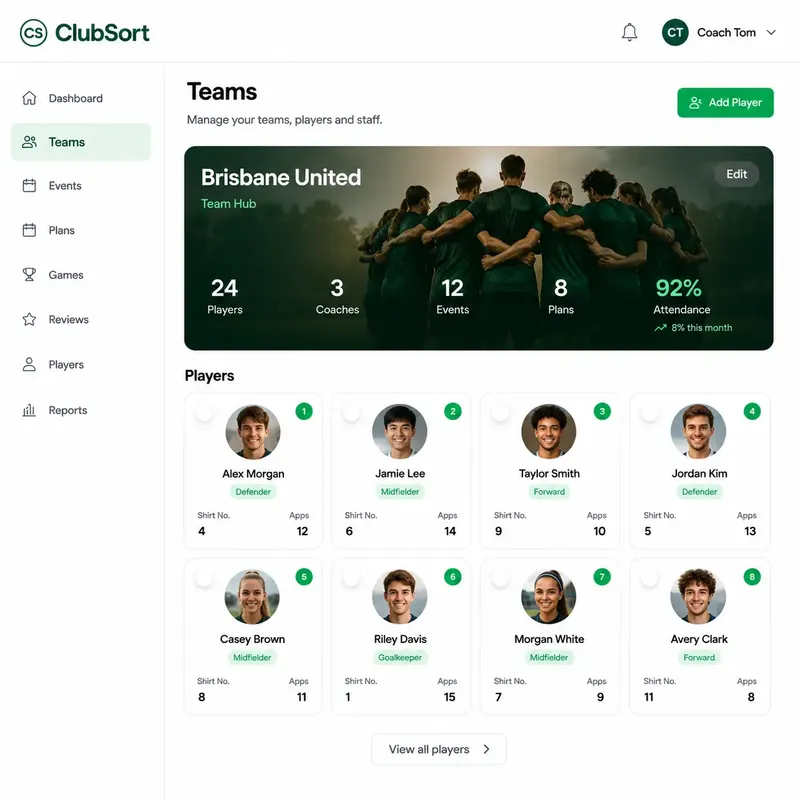
ClubSort starts with the structure of the club and follows the relationships that matter.
- A player has a Profile.
- That profile can belong to a Team through a membership.
- The team has Coaches and Managers.
- The team has Events.
- Those events have Attendance.
- Training can be supported by Plans.
- Games can be managed through Game Tracking.
- Player development can be structured through Assessments and Reviews.
- Reporting can be prepared.
Each part is connected. That connection is important because the information doesn't have to be recreated every time someone needs it.
The goal isn't to store more information. It's to make the information you already have more useful.
The coaching layer between systems
This is where ClubSort sits differently from registration and general club administration platforms.
- A registration system is primarily concerned with getting players into the club.
- A competition system is concerned with organising competitions, fixtures and results.
- An accounting system is concerned with money.
Those things are important.
But they don't necessarily describe what happens between a coach and their players every week. That's the coaching layer ClubSort is built to support.
Plan. Train. Communicate. Play. Track. Review. Develop.
It's the operational side of actually running the team.
Coaching is at the centre
One of the things we've become increasingly conscious of while building ClubSort is that coaches don't want another administration system, they want tools that help them coach.
That's why Plans are more than simple text notes. A coach can structure a session, use visual activities and build a library of sessions that can be reused and shared with a vibrant marketplace planned.
And that's why player development isn't just a profile field.
Assessments allow a club to define what it wants to develop, while Reviews give coaches a structured way to reflect on an individual player's progress.
The aim is to connect what a club says it wants to develop with what actually happens at training and during games.
Games are part of the development picture
The same thinking applies on game day:
- A game isn't simply an event with a score.
- Players participate.
- Coaches make decisions.
Periods progress.
- Players move between the field and bench.
- Participation matters.
ClubSort's Game Tracker is designed to make that information easier to manage while the game is actually happening.
Age groups can define team sizes and match periods. Teams provide the players. The game uses that structure.
The result is less manual setup and a better record of what actually happened.
And that information can become part of the bigger picture of player development.
It doesn't have to replace everything
This is probably the most important distinction: we don't believe a club necessarily needs one giant system that does absolutely everything.
- A club may already have a registration platform it likes.
- It may use a governing-body competition system.
- It may have accounting software that works well.
- It may use another service for a particular administrative requirement.
That's okay.
ClubSort doesn't need to replace every system a club uses to be valuable.
In fact, we think there is a strong case for doing the opposite.
Use the right system for the right job.
Registration can remain registration. Competition management can remain competition management. Accounting can remain accounting.
ClubSort can focus on the teams.
What about the mobile app?
This distinction also influences how ClubSort is delivered.
Club administrators may spend much of their time in the web application managing the structure of the club.
Coaches and managers need to work with their teams. Players and families need access to the information relevant to them.
That's why ClubSort is being built with mobile use in mind rather than treating mobile as simply a smaller version of the administration system.
The ClubSort app is intended for the everyday experience of being part of a club.
And ClubSort Live provides a simpler, read-only experience for people who just want to follow what's happening in a live game.
The technology follows the people and the job they are trying to do.
Where does this leave the price?
We don't think ClubSort should compete simply by being the cheapest club software.
The real comparison isn't necessarily another $50 or $100 monthly subscription.
It's the amount of volunteer and coaching time spent searching, copying, updating, chasing and maintaining information.
If a coach can prepare a training session faster, if a manager doesn't need to maintain three spreadsheets, if a player can see their event information without someone sending another message, or if a club can have a meaningful development conversation without rebuilding a player's history, the value is bigger than the software subscription itself.
The product has to earn that value.
That's what we're trying to build.
The opportunity is between the systems
Perhaps the most interesting part of ClubSort isn't any individual feature.
It's what happens when the features are connected.
- A player doesn't just exist as a registration, they belong to a team.
- The team has events.
- The coach creates plans.
- Players attend training.
- The team plays games.
- Game participation is recorded.
- The club assesses development.
- The coach completes a review.
That creates a continuous picture of the sporting experience rather than a collection of disconnected administrative records.
And that is the problem we want ClubSort to solve.
We're not trying to replace every system
There are already very good systems designed to solve many of the administrative problems clubs face. We don't need ClubSort to become another giant administration platform just for the sake of having more features. We want it to be exceptionally good at the part that matters to the people actually delivering the sport.
- The coaches.
- The managers.
- The players.
- The teams.
- The people responsible for helping players develop.
Because once registration is finished, that's when the season really begins.
ClubSort is the coaching layer that starts after registration.